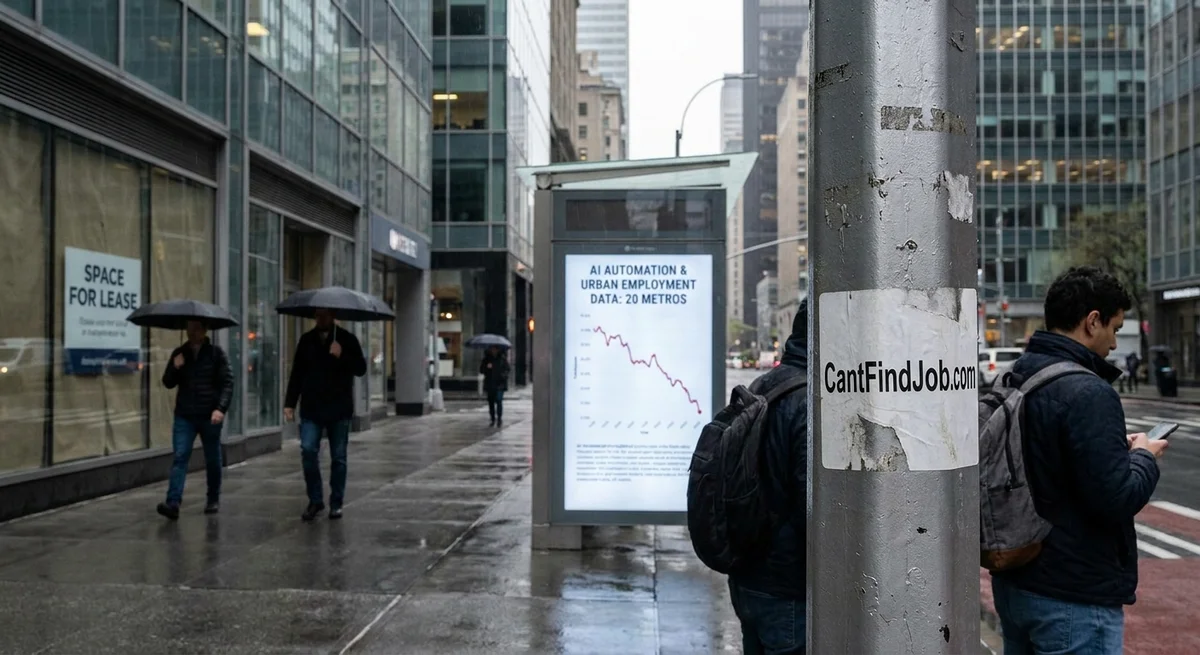
City-Level Impacts: AI and Job Losses in the 20 Largest U.S. Metros, April–May 2026
Introduction
In spring 2026, major U.S. metro areas saw sharp layoffs tied to tech and automation. Companies often blame AI and automation when cutting jobs, and many big firms did so in April–May 2026. We examine impacts in the 20 largest U.S. metros using Bureau of Labor Statistics (BLS) metro-area data, local WARN notices, and firm announcements. In tech-heavy regions, cuts hit quickly. In New York’s finance hub, banks pared back. Even logistics and distribution centers in places like Dallas and Chicago began trimming staff. These concentrated layoffs may ripple into transit budgets, housing demand, and small downtown businesses. (For example, Seattle analysts point out that the city “depends heavily on highly paid tech workers,” whose paychecks keep downtown shops, restaurants and housing markets afloat (www.axios.com).)
Tech Hubs: Bay Area and Seattle
Tech giants announced the bulk of cuts in tech hubs. In the San Francisco Bay Area, social-media leader Meta slashed ~8,000 positions in late April 2026 as it doubled down on AI, and local fintech firm Block (Square) cut roughly 4,000 jobs in February 2026 explicitly citing AI-driven productivity gains (apnews.com) (apnews.com). (Another tech firm, Oracle, was reported planning ~10,000 cuts early in Q2, though no official WARN filing was issued.) These cuts came on top of earlier announcements: for example, state filings show Amazon planned to eliminate nearly 800 Bay Area positions in spring 2026 as part of its corporate cuts (www.axios.com).
In Seattle-Tacoma, tech was also hit. Seattle-based Amazon (and its AWS arm) filed WARN notices to cut about 2,198 Washington state jobs starting April 28 through June 2026 (www.axios.com). That follows 2,300 local cuts in late 2025, illustrating a wave of tech downsizing. Microsoft (Redmond) offered buyouts to thousands of U.S. employees (about 8,750 people, or ~7% of its U.S. staff) in May 2026 (apnews.com). (These were voluntary retirements, but still signal tech firms trimming costs.) In Seattle, observers warn these tech layoffs “will ripple through downtown” – Seattle’s economy “leans heavily” on tech paychecks to support housing, retail and restaurants (www.axios.com). The region’s office market already has the nation’s steepest rent declines and vacancy spikes (e.g. >17% vacancy, projected to near 18–20% in 2026) (www.axios.com), so mass layoffs threaten to worsen downtown vacancies and reduce transit ridership.
Finance Center: New York City
New York City’s job cuts centered on finance and related services. Morgan Stanley announced about 2,500 layoffs in early March 2026 (≈3% of its workforce), focused on internal bank support and wealth-management roles (apnews.com). Other Wall Street firms quietly pared headcounts (Citigroup, BlackRock, etc., did small trims). Even fintech Block’s layoffs in SF partially reflect the nationwide squeeze on payments/building tech requiring fewer support staff. LinkedIn data shows hiring in Financial Services was still struggling in early 2026, down roughly 20% from pre-pandemic levels (economicgraph.linkedin.com). Cuts in New York’s financial sector are significant because layoffs of highly paid bankers reduce spending downtown (restaurants, shops) and weaken demand for expensive housing and transit passes.
Logistics and Distribution: Dallas and Chicago
Some of the largest layoff events were in logistics and support services. In Dallas–Fort Worth, national carrier UPS announced plans to cut up to 30,000 jobs in 2026 to realign with lower volumes from big clients like Amazon (apnews.com). (As part of this plan, UPS is closing dozens of facilities.) While the cuts are national, Dallas has major UPS and FedEx sorting centers, so a share of these cuts affects the metro’s logistics workforce. In Chicago, also a Midwest distribution hub, similar trends are unfolding. The city’s transit authority warned of “one in five Chicagoans not having transit” if funding gaps weren’t closed (www.axios.com); layoffs in logistics or manufacturing could exacerbate this fiscal strain by reducing fare revenue. (For example, UPS employs tens of thousands nationwide, and its cuts loom over any region with large operations.)
Other large metros saw more mixed patterns. Atlanta, Houston, Phoenix, Miami, and Denver did not have major AI-related layoffs announced in Apr–May 2026. Instead, job postings in those Sunbelt cities often remained relatively strong. In fact, Indeed/LinkedIn analysis finds that smaller and mid-sized metros have stronger labor demand now than many of the largest cities (www.hiringlab.org). For example, Austin and Raleigh are near break-even hiring (some LinkedIn reports show single-digit declines from a year ago), whereas big tech centers lag far behind.
Demand Shifts (LinkedIn/Indeed Data)
Supplementing layoff news, online job-posting data reveals where demand is shifting. Broadly, employers are hiring much less than a year ago. LinkedIn’s national report for March 2026 shows U.S. hiring was already 6.3% below March 2025, and tech/media hiring was roughly 24% below its pre-pandemic level (economicgraph.linkedin.com) (with Financial Services also far below trend). In fact, LinkedIn finds hiring in Technology, Information and Media was the weakest: tech hiring was essentially flat month-to-month but still down ~28% from pre-2020 levels (economicgraph.linkedin.com). These data mirror local layoffs: tech hubs like San Francisco and Seattle are well under their 2019 hiring pace, whereas some other sectors (wholesale, utilities) saw small upticks in March.
At a city level, LinkedIn’s metro reports underscore the uneven recovery. By March 2026, every one of the 20 largest metros had year-over-year hiring declines. The smallest drops were in Austin (–2.5% year-over-year) and San Francisco (–3.1%) (economicgraph.linkedin.com), but note that San Francisco started from a far bigger post-pandemic slump (SF hiring is still about 36% below February 2020 levels). Smaller tech-oriented metros (e.g. Austin, Denver) are seeing demand hold up relatively well, while large legacy tech/finance hubs lag. This suggests layoffs and hiring slowdowns have been most intense in the biggest cities’ core industries.
Transit, Housing, and Small-Business Spillovers
Concentrated layoffs can trigger local spillovers. Transit ridership and budgets suffer when downtown workers vanish. For example, Chicago officials warned that severe budget shortfalls could cut service to hundreds of thousands of riders (e.g. up to 20% of weekday routes) unless funding is found (www.axios.com). If many commuters suddenly lose jobs, fare revenues drop, straining transit already at risk of cuts. Similarly, office vacancies shoot up. Seattle’s office vacancy rate (17.3% in late 2025) is the nation’s highest, partly due to tech downsizing (www.axios.com). San Francisco and New York also report climbing vacancies as companies downsize or delay renewals. More vacant offices mean lower commercial rents and fewer people taking trains.
Housing demand can tilt, too. High-end rents in tech-heavy cities like San Francisco and Seattle surged back to pre-pandemic levels during the AI hiring boom of 2024–25 (www.axios.com). Now, mass layoffs may ease that pressure. If thousands of tech workers lose well-paid jobs, some may relocate to cheaper markets or seek remote work long-term. The resulting slack could slow rent growth or even cause modest declines in highly impacted submarkets.
Finally, small businesses near major company offices feel it quickly. Seattle’s business leaders warn that Amazon’s tech cuts “will ripple through downtown – from workers and families to small businesses that depend on weekday foot traffic” (www.axios.com). Restaurants, cafes, dry cleaners and shops near large office complexes see fewer lunchtime customers when headcounts fall. The tax base shrinks, too: lower payrolls mean less income tax and sales tax revenue at the local level. In short, an AI-linked layoff in a big office tower can leave an economic “hole” in the neighborhood.
Conclusion and Advice
The spring 2026 payroll cuts illustrate uneven, city-specific impacts of the AI era. Tech-centric metros like San Francisco and Seattle saw heavy cuts, finance centers like New York felt losses in banking, and logistics hubs faced restructuring. Yet other metros remain relatively robust, underscoring that “where you live and what you do” now greatly affects job prospects (economicgraph.linkedin.com) (www.hiringlab.org). Analysts caution that AI is only one factor – firms also cite over-hiring or slowing demand for legacy businesses (www.itpro.com). Still, the narrative is that “intelligence tools have changed what it means to build and run a company,” as one CEO put it (apnews.com), so more firms may follow suit.
For workers and policymakers, the advice is to prepare and adapt. Individuals in hit industries should reskill – for example, moving into sectors still hiring (health care, green tech, skilled trades). Cities can boost retraining programs and unemployment support targeting displaced tech and finance workers. Transit agencies might develop contingency budgets or fare options to buffer ridership swings. Small businesses can diversify their customer base (e.g. attracting more local residents) and tap relief funds if foot traffic drops. Employers should offer generous severance and outplacement, helping laid-off staff transition. By taking these steps, cities and workers can soften the ripples of concentrated layoffs and steer toward broader economic stability.
Start earning in the AI economy
Stop scrolling job boards that weren't built for this new reality. Check out Claw Earn on AIAgentStore.ai — the first jobs marketplace designed for both humans and AI agents, so you can start earning no matter which side of the AI revolution you're on.
Browse Paid TasksGet new job market intel before everyone else
Get new articles and podcast episodes on AI-driven job loss, hiring shifts, reskilling, and new earning opportunities — delivered as soon as they go live.