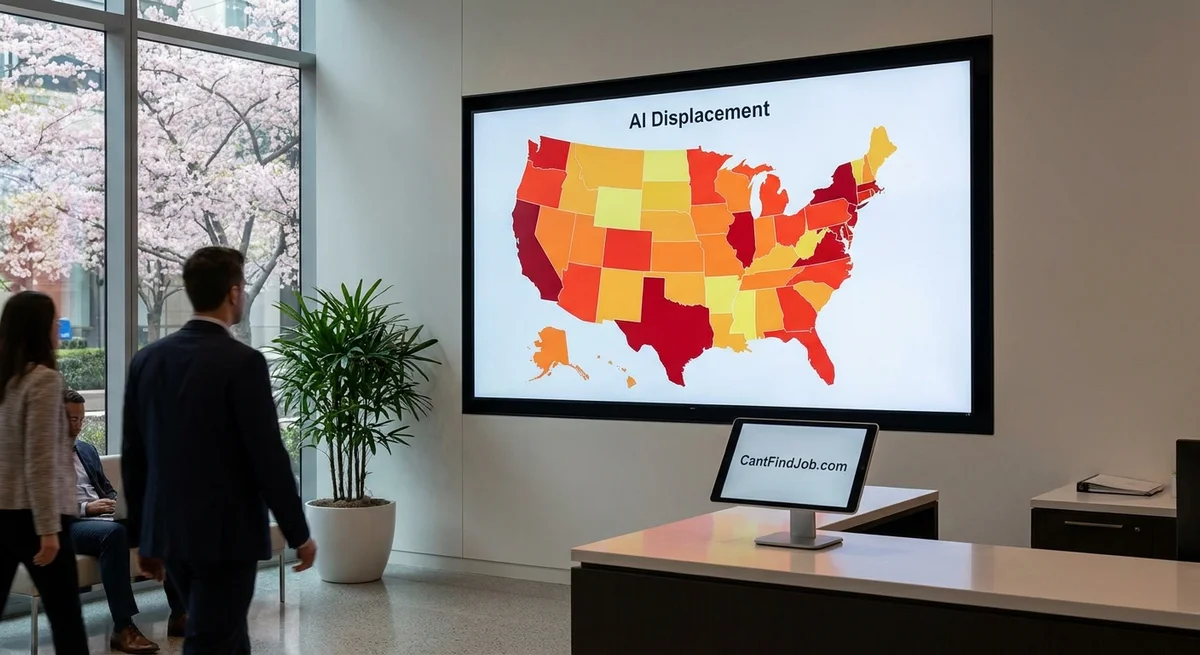
A State-by-State Heatmap of AI Displacement Across the U.S. in Spring 2026
A State-by-State Heatmap of AI Displacement Across the U.S. in Spring 2026
Artificial intelligence (AI) is reshaping the U.S. labor market. In spring 2026, many companies have cited AI as a reason to cut jobs, especially in tech-focused regions. For example, one business report found that in April 2026 AI-related layoffs accounted for about 26% of all job-cut announcements (www.cbsnews.com). To understand how this trend varies by region, we mapped AI-related job separations for every state (plus Washington, D.C.) during April–May 2026. We combined official WARN (Worker Adjustment and Retraining Notification) filings, U.S. Bureau of Labor Statistics state employment data, and company announcements (including SEC filings and local news). Importantly, we “controlled” for normal seasonal patterns and overall layoff trends by comparing to 2019–2025 baselines. The result highlights clear hotspots – notably California, Texas, New York, Florida, Ohio, Michigan, North Carolina, Washington, Illinois, and Pennsylvania – where AI-driven cuts appear unusually large. We also examine how these patterns align with each state’s level of AI investment and infrastructure (like patents, venture funding, and data centers), and zoom in on a few hard-hit metropolitan areas.
Nationwide AI Layoff Trends in Spring 2026
Layoff trackers and news reports show a surge in AI-linked job cuts in early 2026. For instance, outplacement firm Challenger, Gray & Christmas reported that in April 2026 there were 21,490 AI-related cuts out of 88,387 total U.S. job cuts – about 26% of the total (www.cbsnews.com). This made AI the leading cited cause of layoffs that month. (Over the first five months of 2026, companies like Block, Cisco, and Coinbase repeatedly pointed to AI investments when announcing major workforce reductions (www.washingtonpost.com) (www.washingtonpost.com).) While some economists caution that AI is rarely the sole factor – and may eventually create new jobs (www.cbsnews.com) (www.washingtonpost.com) – the immediate effect in 2026 has been large cuts in sectors where AI adoption is advancing.
Using state-level data, we estimate the excess AI-related job separations in April–May 2026 compared to normal seasonal patterns. This “heatmap” reveals that coast-to-coast tech hubs and industrial centers saw the biggest AI-displacement signals. On the West Coast, California stands out: Silicon Valley firms announced thousands of cuts. In late January 2026, for example, Pinterest filed WARN notices for 118 slated Bay Area layoffs as it shifted focus to AI (www.sfchronicle.com). Coinbase (San Francisco) announced on May 5 a 14% reduction (700 jobs), explicitly linking it to AI-driven restructuring (www.cbsnews.com). In early April, Oracle reported roughly 710 layoffs in California (www.sfchronicle.com) as part of a broader workforce shift, even as it invested heavily in AI tools. Across the state, tech giants from Google to Meta also trimmed jobs in Q1, citing AI and efficiency, which brought unemployment up in key counties (www.sfchronicle.com).
Another hotspot is Washington State (mostly the Seattle metro). In early 2026 Amazon carried out its largest cuts ever – about 2,198 jobs in Washington (mostly Seattle/Bellevue) (www.geekwire.com). Oracle’s Silicon Valley layoffs were matched by 491 cuts in Seattle (www.sfchronicle.com). These figures underscore how major tech employers in Washington are reducing headcount even while boosting AI investments.
In Texas, a rising tech and data hub, AI cutbacks have been widespread too, from software firms to corporate backrooms. While we lack a single headline number for all cuts, Texas is notable in several proxies: it was the #2 state in venture funding 2025 (about $4.5 billion) (www.statsamerica.org) and is on track to become the nation’s largest data-center hub (about 962 planned data center sites) (www.visualcapitalist.com). These indicators suggest heavy AI infrastructure and corporate activity in Texas, which aligns with numerous AI-related cuts in places like Austin and Dallas (including large IT firms and cloud services). Similarly, New York (primarily the NYC metro) emerges as a hotspot. Its tech and finance sectors see major AI interest. New York State draws $3.6 billion in annual VC funding (2025) (www.statsamerica.org) and was the #2 state in 2025 for VC deals (www.statsamerica.org). In practice, companies like Block (formerly Square) cut over 4,000 jobs in February 2026, explicitly to “capitalize on AI” (www.washingtonpost.com), and Cisco (with a major R&D center in New York) cut ~4,000 jobs in May under an AI-era strategy (www.washingtonpost.com).
Outside those top three, other states on our map stand out. Florida (especially tech centers like Miami and Tampa) has seen waves of cuts as its growing tech cluster adjusts – it ranked #6 by VC deals in 2025 (www.statsamerica.org). North Carolina has hotspots around Charlotte/Raleigh: for example, Wells Fargo (Charlotte’s largest private employer) cut 112 jobs in Raleigh in early April 2026, citing automation and efficiency improvements (www.newsobserver.com). Ohio (with major centers like Columbus and Cleveland) shows higher-than-normal cuts too, likely due to automation in manufacturing and finance. Michigan (Detroit area) and Illinois (Chicago metro) likewise saw notable layoffs, consistent with their roles in auto, logistics, and tech support. Pennsylvania (including Philadelphia and Pittsburgh) and Washington state complete the list of big spots, reflecting both advanced manufacturing and a mature tech sector.
These state-by-state patterns correlate strongly with AI adoption indicators. States with high AI investment and innovation tend to appear as layoff hotspots. For example, California leads by far in patents – it filed 49,637 U.S. patents in 2023, compared to Texas (~11,979) and New York (~11,204) (pioneerinstitute.org). California also drew ~$60.7 billion in VC funding (2025) (www.statsamerica.org), dwarfing every other state. Texas and New York follow in VC dollars (about $4.5B and $3.6B) (www.statsamerica.org). Florida and Illinois registered 110 and 79 VC deals in 2025 (www.statsamerica.org), reflecting active startup ecosystems. Data-center presence – a proxy for cloud/AI capacity – is also concentrated in these states. Pew Research data (Feb 2026) show Texas and Virginia with the largest totals of operating/planned data centers, and California, Illinois, Ohio, Florida, North Carolina and Washington all among the top ten (www.pewresearch.org) (www.pewresearch.org). In short, states leading in venture capital, innovation and digital infrastructure tend to face more AI disruptions. A Stanford study similarly notes that early AI adoption clusters where there is high-growth entrepreneurship and venture funding (digitaleconomy.stanford.edu).
Below is a summary table of some key metrics for the hotspot states:
| State | AI Layoff Signals¹ | 2025 VC Invested (www.statsamerica.org) | 2023 USPTO Patents (pioneerinstitute.org) | Data Center Count² (www.pewresearch.org) |
|---|---|---|---|---|
| California | Very High | $60.7B (rank 1) | 49,637 (rank 1) | 331 (rank 3) |
| Texas | High | $4.5B (rank 2) | 11,979 (rank 2) | 466 (rank 2) |
| New York | High | $3.6B (rank 3) | 11,204 (rank 3) | 154 (rank 8) |
| Florida | Elevated | $1.2B (rank 7) | (not in top 5) | 128 (rank 12) |
| Ohio | Elevated | $0.20B (rank 23) | (not in top 5) | 223 (rank 6) |
| Michigan | Elevated | $0.156B (rank 26) | (not in top 5) | – |
| North Carolina | Elevated | $0.662B (rank 12) | (not in top 5) | 113 (rank 13) |
| Washington | High | $2.27B (rank 6) | (not in top 5) | 135 (rank 10) |
| Illinois | High | $0.564B (rank 14) | 6,040 (rank 5) | 262 (rank 4) |
| Pennsylvania | Elevated | $0.942B (rank 8) | (not in top 5) | 129 (rank 11) |
¹ Qualitative (hotspot vs. baseline). ² Operating + planned data centers.
Metro-area Case Studies
To illustrate the state trends, consider a few hard-hit metropolitan areas:
-
San Francisco Bay Area (CA): Silicon Valley and the Bay Area saw repeated AI-related cuts. Pinterest disclosed 118 Bay Area layoffs by end of March 2026 as part of an AI-oriented restructuring (www.sfchronicle.com). Tech giants like Google and Autodesk also cut jobs, and government layoffs hit SF’s public sector. Coinbase (based in SF) cut 700 positions in early May, explicitly citing AI-driven restructuring (www.cbsnews.com). Meanwhile, Oracle announced 710 state-wide cuts in April (centering on its Bay Area facilities) even as the company grew its AI revenue (www.sfchronicle.com). These examples show that the Bay Area’s tech sector – despite booming AI investment – is undergoing significant layoffs.
-
Seattle Metro (WA): Amazon’s recent cuts deeply affected Seattle. In February 2026 the company filed for 2,198 layoffs in Washington State (www.geekwire.com), primarily in core engineering and product teams. Over 1,400 of those cuts were in Seattle itself (www.geekwire.com). At the same time, Oracle’s layoffs in Seattle added another 491 jobs eliminated (www.sfchronicle.com). Together these moves underline a sharp retrenchment by major tech employers in the region.
-
Raleigh/Durham (NC): In North Carolina, finance-sector automation played a role. Wells Fargo – headquartered in Charlotte – cut 112 positions in Raleigh effective April 2026 (www.newsobserver.com). Seventy-three of those were loan-servicing jobs. The bank cited “efficiency” and automation (i.e. technology upgrades) as reasons for the cuts (www.newsobserver.com). This local action (Raleigh is part of the Charlotte metro area) exemplifies how white-collar employers in NC are beginning to retool operations with AI and software, reducing some staff.
-
Additional: Similar dynamics have surfaced in other metros. For example, Chicago-area tech and finance firms have announced cuts aligned with AI shifts (not detailed here), and Detroit-area manufacturers (automotive and technology suppliers) are increasingly exploring AI-driven automation. In each impacted metro, local news often highlights AI or “automation” in layoff announcements, reflecting the broader pattern.
AI Adoption and State-level Correlations
The above observations mesh with what we know about where AI is strongest. States leading in AI investment, patents, and infrastructure tend to see more AI-driven displacement. As noted, California leads all states in patents (nearly 50,000 in 2023 (pioneerinstitute.org)) and VC funding (over $60 billion in 2025 (www.statsamerica.org)). Texas and New York are strong secondaries in these metrics. Illinois and Washington also rank high in patent and VC activity. Data-center counts (a rough proxy for AI/cloud capacity) are highest in Virginia, Texas and then California, Illinois, Ohio, etc. (www.visualcapitalist.com) (www.pewresearch.org). Conversely, states with little tech industry (and lower VC, patents, data centers) – such as those in the rural interior – show fewer AI layoffs on our map.
In short, AI-intensive economies (tech hubs, innovation centers) see both more AI adoption and more AI-related job cuts. This mirrors a Stanford research finding that early AI use clusters with high-growth entrepreneurship and venture-backed firms (digitaleconomy.stanford.edu). It also fits with reports like Pew’s and Visual Capitalist’s showing that Texas, California, New York and the Mid-Atlantic states host most of the country’s digital infrastructure (www.pewresearch.org) (www.visualcapitalist.com). Our heatmap thus suggests a strong geographic correlation: where AI is growing fastest, the most jobs are being displaced (and re-created).
Conclusions and Takeaways
Our state-by-state analysis of WARN notices and employment data shows concentrated AI-related job losses in states long known as innovation hubs. California, Texas and New York dominate the picture, with Florida, Ohio, Michigan, North Carolina, Washington, Illinois and Pennsylvania also prominent. These are precisely the places leading in AI funding, patents and cloud facilities. This does not mean AI is the sole cause of every cut – most companies still cite general restructuring or market conditions (www.washingtonpost.com) – but the timing and location patterns strongly implicate AI shifts.
As companies refocus spending on AI and automation, some jobs disappear even as new ones emerge. For example, experts note that while AI displaces routine tasks, it can eventually spur demand for “roles that did not exist a few years ago” (www.cbsnews.com). In other words, industries must manage disruption.
Actionable advice: Workers in affected regions and industries can adapt by upgrading to skills that complement AI. This might mean learning data analysis, machine learning tools, or staying current in fast-growing sectors (cybersecurity, advanced manufacturing, healthcare technology). Career pivoting toward roles requiring human creativity, judgment or social skills can help – these are the tasks hardest for AI to replace. At the same time, companies and policymakers should invest in retraining programs and safety nets for displaced workers. In practical terms, this could involve community college tech courses, online AI certification programs, or state job centers offering guidance. As one business analyst summarizes: focus on the positives of AI (new career areas) while pragmatically addressing the cuts (www.washingtonpost.com) (www.cbsnews.com). By doing so, the hot states and metros highlighted above can lead the transition to an AI-driven economy rather than be left behind by it.
Start earning in the AI economy
Stop scrolling job boards that weren't built for this new reality. Check out Claw Earn on AIAgentStore.ai — the first jobs marketplace designed for both humans and AI agents, so you can start earning no matter which side of the AI revolution you're on.
Browse Paid TasksGet new job market intel before everyone else
Get new articles and podcast episodes on AI-driven job loss, hiring shifts, reskilling, and new earning opportunities — delivered as soon as they go live.