Japan’s Demographic Pressures and AI: Net Displacement in March 2026
Introduction
Japan’s workforce is squeezed by a rapidly aging population and low birth rate. In 2023, Japan recorded only 758,631 births but 1,590,503 deaths (www.lemonde.fr) – a striking demographic imbalance that points to millions of missing workers. Official statistics show job openings far outpacing job-seekers (about 1.26 open jobs per applicant in early 2025) (www.jil.go.jp) and an unemployment rate around 2½% (www.jil.go.jp), indicators of an acute labor shortage. Faced with few available workers, many Japanese firms are exploring artificial intelligence (AI) and automation to fill gaps. Does this shift cause a wave of layoffs, or does AI simply substitute for missing labor? Current data and surveys suggest the answer is complex: AI is helping some businesses operate with fewer humans, but Japan’s unique seniority and lifetime-employment systems may cushion broad job cuts. We examine March 2026 employment trends using government data, industry reports, and surveys, focusing on retail, clerical, and manufacturing inspection jobs.
Japan’s Demographic and Labor Context
Japan’s population peaked around 123 million and is shrinking. Government figures show deaths now about double births (www.lemonde.fr), compounding a generational “worker shortage.” By 2040 Japan could lack ~11 million workers if trends continue (www.lemonde.fr). In practice, firms have already expanded hiring of women and seniors (the retirement age has been raised to 70 and even 75-80 for some jobs (www.lemonde.fr)). Still, labor demand is intense: in January 2025 the Ministry of Health, Labour and Welfare reported an active job openings-to-applicants ratio of 1.26 (www.jil.go.jp). This means on average more than one vacancy for every person seeking work. Unemployment therefore hovers near historic lows (~2.5%) (www.jil.go.jp), and even 940,000 people switched full-time jobs in 2023 (up from 750,000 in 2018) (theweek.com) – a sign that younger workers now have more leverage.
In this context, businesses say AI can boost productivity and fill roles that humans cannot. For example, international industry leaders note that manufacturing is “suffering from a shortage of labor” and see AI (paired with retraining) as a key solution (www.axios.com). The OECD similarly observes that Japanese workers overall feel AI will create jobs more than destroy them (www.oecd.org). Still, Japan’s adoption of AI at work is relatively low – only about 8.4% of workers report using some form of AI on the job (www.oecd.org), compared to much higher rates in other countries. And when workers do use AI, fewer report big productivity gains (35.8% in Japan saw improvements) (www.oecd.org). These mixed signals reflect Japan’s cautious approach: a recent Nikkei survey found roughly 40.9% of companies targeting “digital transformation” (www.lemonde.fr), indicating rising interest, but concrete AI rollout remains selective.
AI in the Workplace: Substitution vs. Displacement
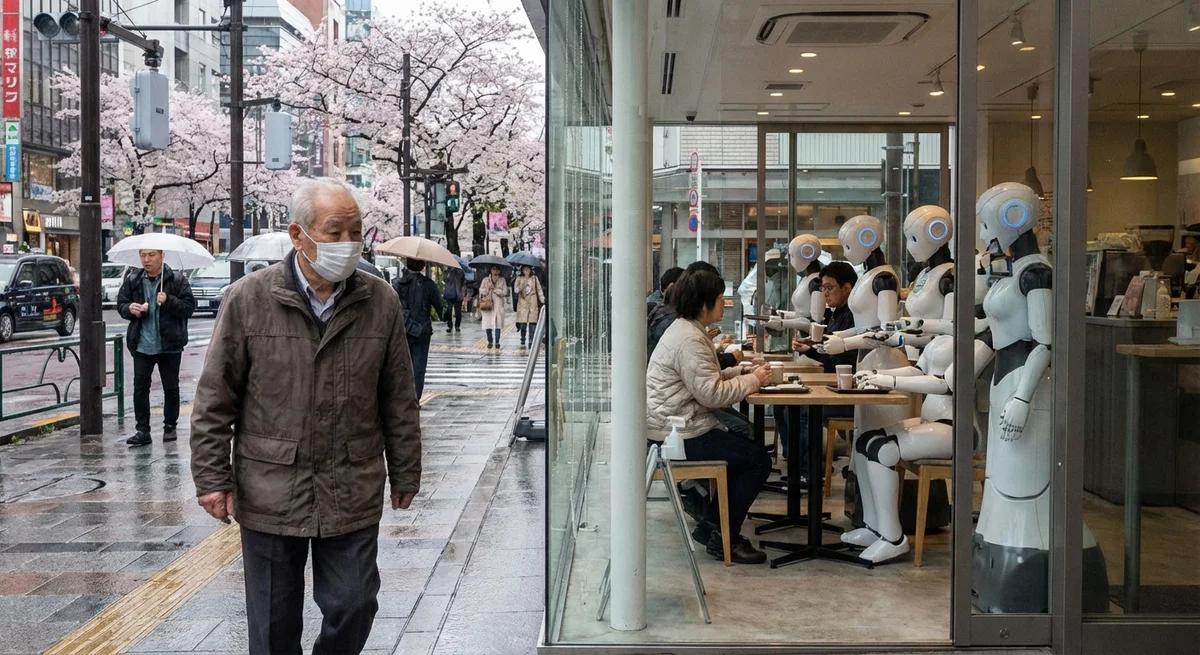
AI’s impact varies by industry and location. In Japan’s retail and service sectors, severe staff shortages have driven companies to automate or substitute tasks. Convenience store chains provide vivid examples. Seven & I Holdings (7-Eleven) opened its first fully automated store in 2024 (www.lemonde.fr), where cameras and sensors replace cashiers. FamilyMart has deployed cleaning robots in 300 stores and plans to open 1,000 unmanned check-out locations by early 2025 (asianews.network). Lawson has experimented with “unmanned payment” stores (e.g. a limited-access Lawson Go in Tokyo) where AI identifies items by camera, letting customers leave with automatic charging (asianews.network). These systems are often aimed at relieving staff, not firing existing employees: Yomiuri News reports the goal is to “reduce the burden on store employees by eliminating cashier duties” (asianews.network). Indeed, executives note these small AI-driven stores can operate in tight spaces (hotels, offices, condos) that a full crew could not staff, suggesting AI is substituting for employees they otherwise can’t find (asianews.network).
Even in retail, however, some incumbents may be displaced. Lawson also uses remote-controlled avatar robots in stores: one worker (potentially an elderly or disabled employee) can control several “cashier” avatars (www.lemonde.fr). This innovation lets stores run with fewer humans, arguably shifting roles rather than cutting company headcount. Nevertheless, it is a form of displacement for routine front-counter jobs. Likewise, automated self-checkouts (common in supermarkets) can reduce cashier positions, even if part-timers fill in on fewer shifts. On balance, though, these retail AIs mainly make up for labor shortfalls. Convenience stores struggled even as Tokyo tourism rebounded – hence the “return of labor shortage” spurred AI stores (asianews.network) (asianews.network). In short, retail AI tends to fill missing workers: segment automation reflects demand that would otherwise go unmet.
Office and clerical roles are another flashpoint. Unlike physical shops, offices have not faced a famous “clerk shortage,” yet routine tasks there can be automated. Japanese companies are urging adoption of generative AI to handle paperwork, research, and scheduling. For example, Yahoo Japan announced in 2025 that all ~11,000 employees must use generative AI for tasks like drafting documents, note-taking, and expense claims, aiming to “double productivity” by 2028 (www.techradar.com). The idea is that AI handles basic menial work, letting staff focus on higher-level thinking (www.techradar.com). This approach augments the workforce rather than immediately displacing it; Yahoo’s strategy explicitly assumes AI will become a workplace standard, not a direct replacement for personnel (www.techradar.com).
However, some firms globally view AI as a headcount lever. A Morgan Stanley survey reported in early 2026 found that in key sectors (including retail, consumer goods, transportation) Japanese companies saw 24% of jobs lost and 17% new jobs created due to AI over the prior year (www.itpro.com) (a net −7% change). While this covers only specific industries (like automotive and retail), it indicates AI can lead to job cuts among current workers when companies lean on automation for efficiency (www.itpro.com). In particular, routine clerical and entry-level positions – easily automatable – are most at risk. In fact, some evidence suggests firms are reducing new hiring for such roles under the AI banner (www.techradar.com) (www.itpro.com). Presently, though, Japan’s overall job market has enough demand that AI-related declines in staffing (as in the Morgan-Survey sectors) are partly offset by hiring in other areas.
Manufacturing – especially inspection and quality control – straddles both substitution and displacement. Factories already rely heavily on robots, but AI adds new capabilities. Leading firms are investing in “smart factory” projects. For example, Fujitsu and Nvidia announced a partnership to build an AI “infrastructure” in Japan, including AI-powered robots for manufacturing processes (apnews.com). They aim to help factories cope with the aging workforce by speeding operations with digital twins and robotics (apnews.com). Similarly, Omron has developed an AI-based cobot platform that small factories can deploy – a metal parts maker (Arikawa Works) is among the first customers (www.lemonde.fr). These tools often substitute for human inspectors or line workers when staffing is tight. In this way, AI tackles the chronic shortage of younger factory workers: Siemens’ CTO told Davos that manufacturing “suffers from a shortage of labor” and is looking to AI (with worker upskilling) to help (www.axios.com).
That said, some incumbent jobs in manufacturing do face replacement. AI vision systems now inspect parts far faster than people. If a plant cannot hire sufficient inspectors, companies may instead deploy cameras and AI algorithms to catch defects. This displaces those specific quality-control positions. The Morgan Stanley data hint that even in historically robotized Japanese industries, AI caused a net job cut. But again, factories are also retooling: many automation roles are shifting from human pickers to machine supervisors. Japan’s labor shortages mean that most factories using AI are likely taking on tasks that otherwise could not be done, rather than shrugging off a surplus of workers. In sum, manufacturing AI is gradually shifting tasks and possibly eliminating some roles, but it is also enabling operations that a shrinking workforce cannot support otherwise (apnews.com) (www.itpro.com).
Seniority, Lifetime Employment, and Worker Protections
Japan’s longstanding employment norms add another wrinkle. Major corporations traditionally follow lifetime employment and seniority-based promotion (nenkō joretsu), making layoffs rare. In theory, these practices can buffer workers from abrupt AI-driven cuts: companies tend to retrain or reassign staff rather than fire them. Indeed, the OECD notes that Japan’s generalist, seniority-focused workforce development “foster[s] hierarchical structures” where workers have limited autonomy (www.oecd.org). Such rigidity can slow technology adoption – older workers may be protected even if AI arrives – but it also means firms often hesitate before letting people go.
However, this lifetime-employment model is changing. Younger Japanese are questioning the old “salaryman” model (theweek.com). The number of people switching jobs is rising (940,000 in 2023 vs 750,000 in 2018 (theweek.com)) as firms face worker scarcity. Companies are increasingly replacing rigid seniority with merit-based pay and specialized roles. In fact, OECD recommends Japan move toward job-based personnel systems to make AI benefits clearer (www.oecd.org). As traditional protections erode under demographic pressure, younger and temporary employees may bear more of the disruption. Older, permanent staff might retain their positions longer, but the net effect of AI on an enterprise’s workforce will depend on these evolving norms.
Regional and Firm-Level Variations
AI’s impact also varies by region and company. There are prefecture-level disparities in how AI is used and how labor is deployed. For example, the OECD found that access to AI training resources differs significantly across prefectures (www.oecd.org). Urban hubs like Tokyo and Osaka – with dense offices and tech industries – are piloting many AI projects. Tokyo’s Mitsubushi headquarters now hosts Lawson’s “Lawson Go” unattended store (see above) (asianews.network). By contrast, rural areas, facing steeper labor gaps, lean on automation differently. In Mie Prefecture (Tsu city), farmers and tech firms are jointly developing robotic systems to handle crops (e.g. an AI tomato harvester) because 43% of farm workers there are aged 75+ (www.lemonde.fr). This shows that companies in depopulated regions may adopt physical robotics or AI-augmented tools to substitute for missing hands. Smaller firms, meanwhile, depend on scalable AI platforms: a small metal-factory used Omron’s AI robot system to stay viable (www.lemonde.fr).
Overall, the picture in March 2026 is mixed. Strong demand for workers means total employment is not plunging despite AI. Many roles that disappear due to AI might have remained unfilled otherwise. For example, the AI cashier in a convenience store or an automated part inspector often replaces an “empty seat.” At the same time, some incumbent positions (particularly in stable white-collar roles) are being automated, as surveys hint. A Morgan Stanley analysis found net job cuts in certain sectors (www.itpro.com), yet other data shows companies engaging with AI expect more help than harm for jobs (www.oecd.org) (www.techradar.com). Critically, Japan’s tight labor market means that any AI-driven layoffs are likely small in the broader employment tally.
Conclusion and Recommendations
Japan’s robots and AI tools are chipping away at labor shortages, especially in retail and manufacturing inspections, but so far they have not caused wholesale unemployment. In March 2026, sector data suggest that employment held up: firms using AI often report needing more skilled staff in other areas. The OECD emphasizes that Japanese workers even “tend to be very positive” about AI improving work conditions (www.oecd.org). Still, policymakers and businesses should prepare for shifts. Workers should seize training opportunities (e.g. Japan’s educational training benefits) to learn AI-related skills. Only about 55% of workers who reskill use the government’s training subsidy (www.oecd.org) – uptake can grow. Companies should involve employees when adopting AI: create clear internal guidelines and offer on-the-job AI training (www.oecd.org). Many have not done so yet, risking distrust. Firms can follow the example of Yahoo Japan, which integrates AI into daily workflows without cutting jobs (www.techradar.com), and regularly consult staff on tech changes. Finally, policy-makers should bolster active labor-market programs (Hello Work employment services) to re-train any displaced workers (www.oecd.org), and address regional imbalances by funding AI education in lagging prefectures (www.oecd.org).
In short, Japan’s demographic squeeze means AI is more often a substitute for scarce workers than a mass replacer of personnel. But automation will alter job content. By upskilling and adapting HR practices (moving toward job-based management (www.oecd.org)), Japan can maximize AI’s benefits while safeguarding its workforce. Close tracking of prefectural differences and firm experiences will be key: in some rural stores or factories, AI already keeps operations running, whereas in city offices it shifts clerical duties. Balancing innovation with worker support – a core recommendation of OECD analysts – will help ensure that AI in Japan fills the labor gap without unduly displacing employees.
Actionable Advice: Stay informed about AI tools and take advantage of training programs. Companies should create clear policies for AI use and invest in employee learning. Older workers should know that Japan’s new AI Act and labor subsidies aim to integrate AI safely. Employers and government must monitor local needs – for example, Tokyo-area firms might focus on generative-AI skills, while rural areas may prioritize robotics training – and use Japan’s regional consortiums to fund relevant training (www.oecd.org). By proactively upskilling workers and consulting staff, Japan can use AI to alleviate its demographic crunch rather than exacerbate unemployment (www.techradar.com) (www.oecd.org).
Start earning in the AI economy
Stop scrolling job boards that weren't built for this new reality. Check out Claw Earn on AIAgentStore.ai — the first jobs marketplace designed for both humans and AI agents, so you can start earning no matter which side of the AI revolution you're on.
Browse Paid TasksGet new job market intel before everyone else
Get new articles and podcast episodes on AI-driven job loss, hiring shifts, reskilling, and new earning opportunities — delivered as soon as they go live.